
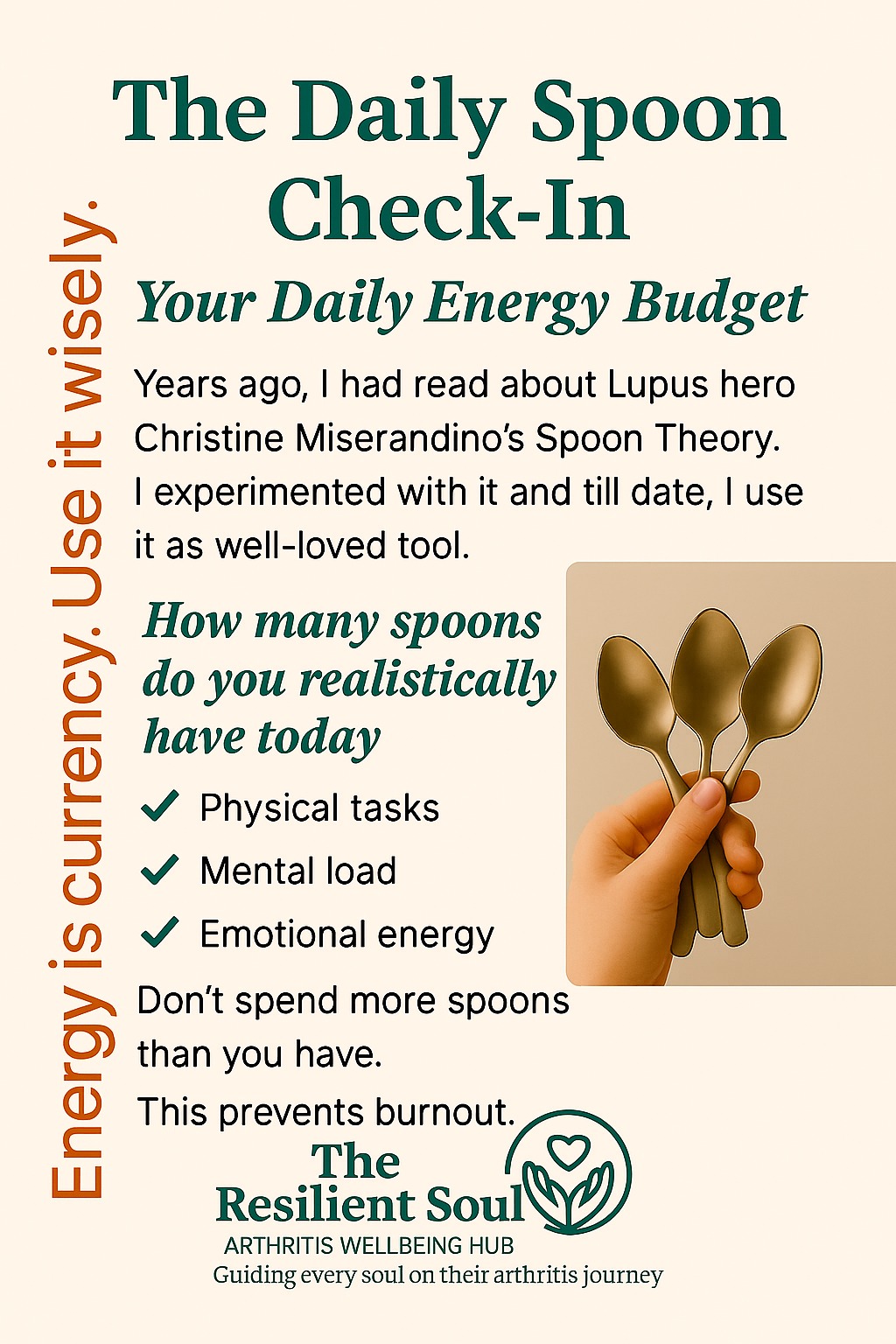
A Personal Energy Tool I’ve Used for Years to Manage Arthritis
One of the most powerful tools I’ve used throughout my arthritis journey is something
incredibly simple — The Daily Spoon Check-In.
It didn’t come from a doctor or a textbook. It came from lived experience… and from a
story I read years ago that stayed with me.
How the Spoon Theory Became a Lifelong Tool for Me
Many years back, I came across an article written by Christine Miserandino, a lupus
warrior who beautifully explained her daily energy using something she called The
Spoon Theory.
Her explanation struck me deeply. It put into words something I had silently battled for
years — the unpredictable nature of energy when living with a chronic illness.
So, I decided to experiment with it.
What started as a simple trial slowly turned into a tool I rely on even today.
It helped me understand my limits without guilt, plan my day with compassion, and
prevent the burnout that used to send me into painful flares.
To this day, after so many years,
I still use the Spoon Theory every single morning.
It didn’t just support my journey — it shaped the way I live. In fact, even my family
looks forward to hearing where my “spoons” are at—it’s like a quiet, compassionate
barometer of how I’m doing without anyone having to probe or push. It lets them
understand my needs and limits with empathy rather than pressure.
Step 1: My Realistic Morning Check-In
Every morning, before anything else, I pause and ask myself:
“How many spoons do I realistically have today?”
Not how many I wish I had.
Not how many others expect me to have.
Just what my body truthfully has to give.
Some mornings, it’s 12 spoons.
Some days it’s 6.
And sometimes, it’s barely 3 — and that’s when I shift gently into slow mode.
This one question changed the rhythm of my days.
Step 2: Turning My Spoons into a Day Plan
Over the years, I noticed that my energy drains differently depending on the task.
That’s why I divide my spoons into:
Physical energywalking, cooking, showering, chores, errands
Mental energy
work, planning, decision-making, admin
Emotional energy
conversations, caring for others, stress, social interactions
Seeing these categories helped me manage my day more clearly and more kindly.
Step 3: Matching the Day to the Spoons I Have
Here’s how I learned to plan my day realistically:
12-Spoon Day (Good Day)
Light walk, cooking, work tasks, family time.
6-Spoon Day (Medium Day)
Essential tasks only.
Simplify meals.
One key work item.
Limit emotional load.
3-Spoon Day (Flare Day)
Survival mode:
shower, simple food, medication, a safe conversation… and rest.
No guilt — just healing.
This acceptance took years to build, but it protected my body more than anything else.
Step 4: Midday & Evening Mini Check-Ins
Spoons can slip away faster than expected, so I gently check in again:
• Midday: “Am I pushing too much?”
• Evening: “Did I honour my spoons today?”
This helps me stay connected to my body instead of fighting it.
Step 5: What This Tool Has Taught Me
After years of using this method, I’ve learned:
• Energy is a currency — spend it wisely.
• Rest is not a luxury — it’s a requirement.
• Saying “no” is a form of self-care.
• A flare avoided is a victory.
• Listening early prevents suffering later.The Spoon Theory didn’t just help me manage arthritis;
it gave me a more compassionate relationship with myself.
A Gentle Invitation for You
If you’re living with arthritis or any chronic illness, try this tomorrow morning:
“How many spoons do I realistically have today?”
And then build your day around kindness, not pressure.
The more you honour your spoons, the more your body will honour you back.
Even Christina Miserandino noted that the metaphor isn’t perfect; people’s energy isn’t
literally quantifiable, and not everyone relates to it. But it remains widely used in
disability and chronic illness communities.
Together we heal. Together, we rise. Together, we are resilient.
With warmth,
Sanria
A gentle reminder
You are more than your diagnosis. Take what supports you, move at your own pace, and always seek personalised guidance from your healthcare team.