
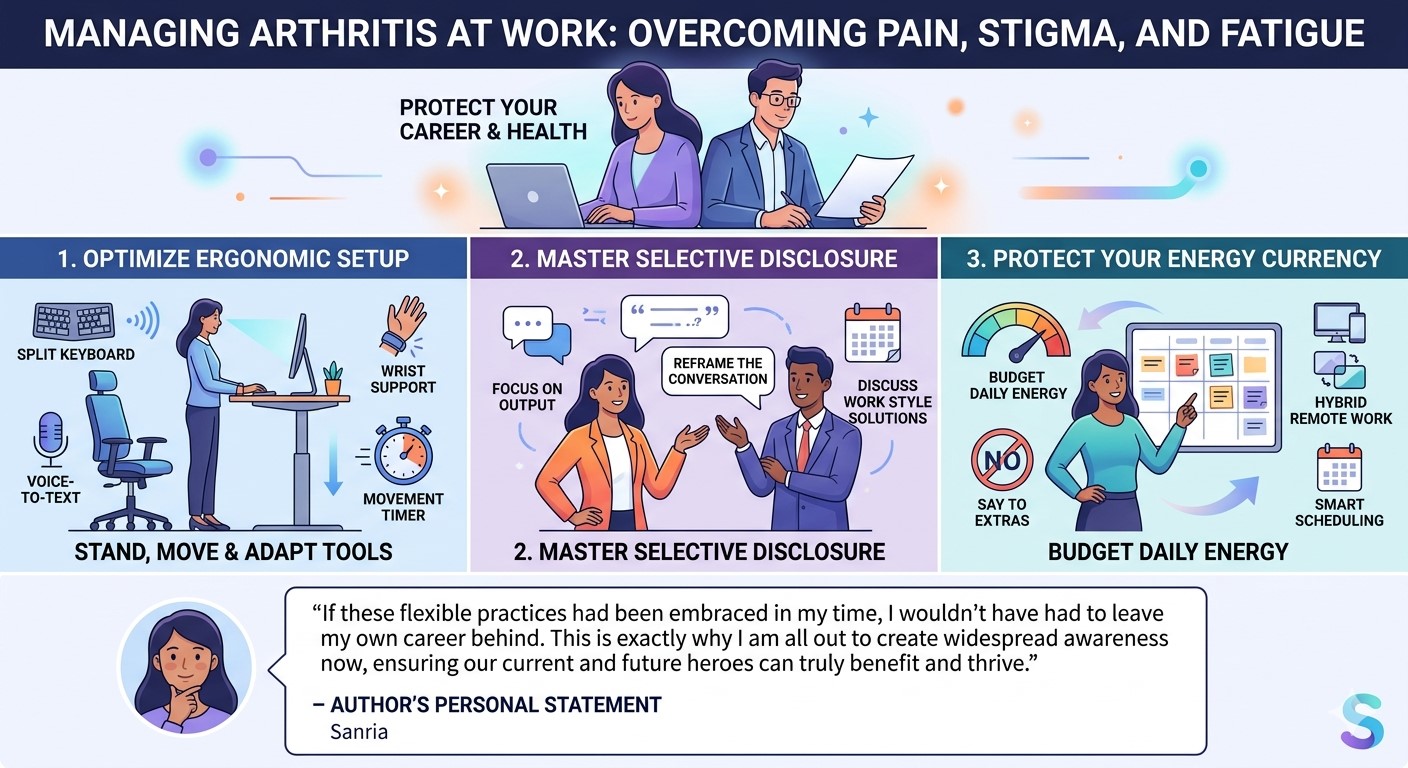
In this third instalment of our Joint Venture Series, we examine the professional landscape. Balancing career ambitions with chronic illness at work is a silent challenge million face daily. How do you protect your career? How do you advocate for your physical needs and manage intense workplace fatigue without losing your professional identity?
For many people, a professional identity brings immense pride, structure, and fulfilment. However, if you are managing arthritis at work, the modern office environment can quickly feel like an obstacle course.
The general public often assumes desk jobs keep your joints safe. The reality is vastly different. Sitting still for eight hours locks up joints like cement. Typing during a hand flare feels like pressing down on shards of glass. Worse yet is the invisible mental exhaustion. Many employees use half their brainpower just to mask their pain to look “100% fine.”
The Hidden Dynamics of Chronic Illness at Work
Navigating a career with chronic pain introduces silent challenges that co-workers rarely see:
- The Presenteeism Trap: Feeling forced to overperform to prove your illness is not hurting productivity.
- The Disclosure Dilemma: Worrying that telling HR or managers will lead to subtle bias or fewer promotions. Navigating this requires a strategic approach—focusing entirely on your work solutions rather than physical limitations.
- The 3:00 PM Crash: The heavy compounding effect of physical pain and mental masking that causes deep mid-afternoon fatigue.
Case Story: The High Cost of Workplace Disbelief
For Ira, an educator with rheumatoid arthritis, workplace skepticism ultimately forced her to resign. Because her severe pain was invisible, administrators dismissed her request for a teaching stool. They labelled the request “unprofessional” and “lazy.” This decision severely complicated her financial stability and healthcare access. According to me, employer education is critical. Employers must actively understand these invisible struggles so top talent is not needlessly driven out of the workforce.
3 Proven Workplace Accommodations for Arthritis
You do not have to choose between your career ambition and your physical health. Use these actionable, non-clinical steps to restructure your workday for longevity. These tips directly target the root causes of ergonomic strain:
1. Optimize Your Ergonomic Office Setup
Small ergonomic changes yield massive long-term relief for inflamed joints. If you work at a traditional desk, advocate for tools that reduce friction:
- Split Keyboards: Use an ergonomic mouse and split keyboard to ease wrist and finger strain.
- Speech-to-Text Software: Utilize voice tools for long emails during hand and finger flare-ups.
- Sit-to-Stand Desks: Install a sit-to-stand desk converter. Alternatively, set a timer that prompts you to stand and gently move for two minutes every half hour to prevent joint locking. For specific gentle movement patterns, see our previous breakdown of arthritis-friendly morning mobility routines.
2. Master the Art of Selective Disclosure
You are never obligated to share your entire medical history. Reframe the conversation around solutions rather than limitations.
- Instead of: “My arthritis is too bad to come into the office.”
- Try: “To maximize my output and manage my mobility effectively this week, I would like to utilize our remote work option on Tuesday and Thursday.”
3. Protect Your Energy Currency
Think of your daily energy as a strict budget. If a meeting can be an email, suggest it. If you have a high-stakes presentation, structure your morning to minimize physical exertion beforehand. Learn to say “no” to non-essential, exhausting office extras without feeling guilty. Managing your energy is a sign of high professional discipline, not a lack of commitment.
A Direct Message to Employers and Managers
To the leaders and colleagues reading this: creating an inclusive environment for an arthritis hero does not require expensive overhaul plans. It requires flexible management.
Offering hybrid remote options, normalizing micro-breaks during long meetings, and focusing on a person’s actual output rather than desk presenteeism can unlock the full potential of an incredibly resilient workforce.
To our heroes: your professional worth is measured by your skills, your creativity, and your unique perspective—not by how fast you can type or how perfectly you sit in an office chair.
“If these flexible practices had been embraced in my time, maybe I wouldn’t have had to leave my own career behind. This is exactly why I am all out to create widespread awareness now, ensuring our current and future heroes can truly benefit and thrive.”
— Sanria
Frequently Asked Questions (FAQ)
How do I talk to my boss about my arthritis?
Focus the conversation strictly on productivity and solutions rather than physical limitations. Request specific adjustments, like a hybrid schedule or ergonomic tools. Demonstrate exactly how they will help you maintain high-quality work output.
Can you get fired for having arthritis?
In many regions, labor laws protect employees with chronic illnesses from discrimination. Employers are often legally required to provide reasonable accommodations if you can perform the core duties of your job.
What are reasonable accommodations for arthritis at work?
Common, low-cost accommodations include speech-to-text software, split ergonomic keyboards, and sit-to-stand desk converters. Designated parking spaces, flexible hours, or remote working setups also provide massive relief.
Together, we heal. Together, we rise. Together, we are resilient.
With Warmth…Sanria
A gentle reminder
You are more than your diagnosis. Take what supports you, move at your own pace, and always seek personalised guidance from your healthcare team.